
It took me a long long time to come up with a good beginning for this piece. But the longer I delayed the process I realised that, much like the movie, there can be no perfect beginning or end for this review. Much like the everything bagel you can bite into the story from any side, any angle.

The critically acclaimed Everything Everywhere All At Once is a movie about the multiverse created by a director who hated the idea of multiverse. The two Daniels responsible for the Academy Award winner, have a fascinating story about coming up with their unconventional story.
In an interview with Radiotimes Daniel Kwan recounted,
“I said, ‘I have a multiverse idea’ and then Scheinert said, ‘I hate multiverses. They make me feel nihilistic thoughts, and nothing matters… Let’s make a movie that’s nihilistic and acknowledges that!’”
Daniel Kwan
This was the birth of an action filled multiverse built around a failing laundromat owner, Evelyn. Michele Yeoh plays the character of Evelyn Wang, a sullen middle-aged Chinese-American woman married to an optimistic and sunny Waymond Wang played by Ke Huy Quan. The duo parent a seemingly disconnected daughter Joy who is trying to get her parents to accept her girlfriend. All of this is the backdrop to the main plot that unfolds at the IRS office.
The Multiverse
The idea of the multiverse has been dominated by superhero movies, particularly Marvel franchise. The multiverse is created as a tool to bring together diverse worlds and storylines. The primary use of the tool being highlighting human unity panning across infinite universes in the face of a great omnipotent evil. The multiverse allows a greater platform for the heroics of the superheroes to shine.
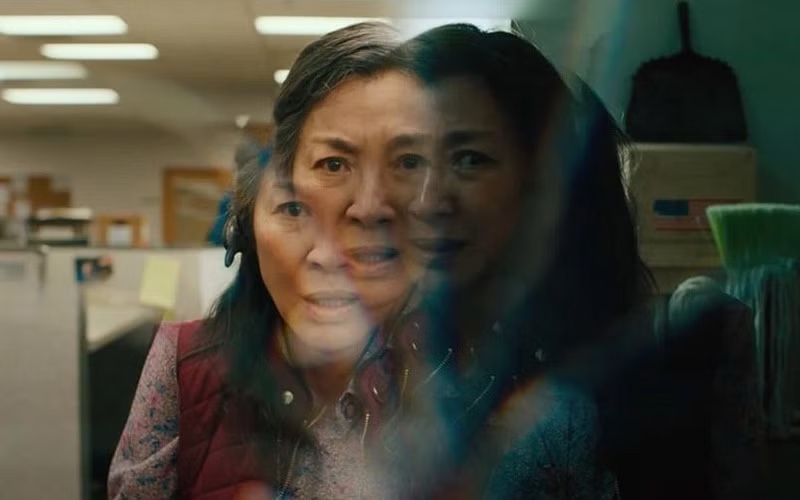
Everything Everywhere All At Once takes these unique attributes of the multiverse and moulds them into a commentary on the modern human predicament. The aha moment for the two Daniels Kwan was when they came to view the multiverse through this perspective. Daniel Kwan said in an interview,
“’Oh, the multiverse is the perfect metaphor for what it feels like to live right now.’ If we can explore all of our neuroses and fears through the multiverse, maybe we can learn something about ourselves. And so that was it, we’re just chasing questions when we’re making movies – we don’t know the answers until we show it in front of an audience sometimes.”
Daniel Kwan
Comic Absurdity
The moments of humour between the heroic action packed sequences of the movie are not just for offering comedic relief. The principle role of these scenes is to highlight the absurdity of human experience. Imagine a world where we have hot dog fingers, how silly would catfights look in that scenario? Or a world where we are rocks, how uncomplicated would emotions be then?

“I think from a philosophical standpoint what we are always looking for are moments in which we can take things that feel comedically absurd, and then reinterpret it and give it new meaning and turn it into something strangely beautiful, strangely meaningful, strangely connected to our characters.”
Daniel Kwan
The multiverse furthers the comedic absurdity by defamiliarising the familiar. It points out the inherent ridiculousness of every random human action. Imagine if you could connect to a parallel reality by snorting a fly, or by confessing your love to a rampaging auditor.
The symbolism of the comedic scenes in the movie makes it possible for the creators to explain a lot of things without having to say them. Thus, even without the words ‘we are condemned to be free’ the viewer is able to feel the futility of not just complex societal interactions but also of their lives.
Read about the numerous references in the movie https://www.bbc.com/news/entertainment-arts-64938320
The Waymond Wang Way
It is one thing to come to the realisation that life is purposeless and meaningless, it is another thing to find a way to deal with the purposelessness and the meaninglessness of life. Our world has already witnessed the rise of existentialism. We know that our lives exist on a tiny speck of infinity which will become obsolete sooner rather than later and much like Sisyphus we are bound to drag our rocks of emotional baggage, trauma, and whatnot, without being able to make a significant change to our lives or to infinity. So, what do we do then?

In the movie, Evelyn gets confronted with her existential crisis. Joy has already witnessed it, and come to terms with it by realising that ‘nothing really matters’ and tries to drag her mother towards her Self destructive belief system. The plot revolves around the mother-daughter duo uncovering this lofty and all encompassing bagel of death to come to terms with their existential crisis, only to be rescued by an unseeming saviour, Waymond.
“The only thing I do know is that we have to be kind. Please, be kind. Especially when we don’t know what is going on”
Waymond Wang
Waymond Wang paves the way towards salvation by uncomplicating the looming danger. He accepts the futility of human life and yet chooses to love humans and humanity. In every alternate universe he stands out as the only character actively resisting the urge to succumb to the chaos of the multiverse. Wether it is Alpha Waymond, the movie star Waymond or even the regular Waymond, his message is clear, love above all else.
The strength of his message is felt in its entirety when one asks the question- if given a chance to exist in any plane of the multiverse would you still choose to live in the reality you are living in? For Waymond the answer is yes, he would choose a life with Evelyn even if it meant that it would be the worst possible kind of life. Waymond would still find a way to brighten the world with googly eyes.

 Deskripted
Leave a comment